EMRIP14: Item 3 – Draft Study and Advice on the Rights of the Indigenous Child under the UN Declaration on the Rights of the Child
13 July 2021
Joint Statement to the 14th session/ Regional meetings of the Expert Mechanism on the Rights of Indigenous Peoples
13 July, 2021 (Asia)
Asia Indigenous Peoples Caucus
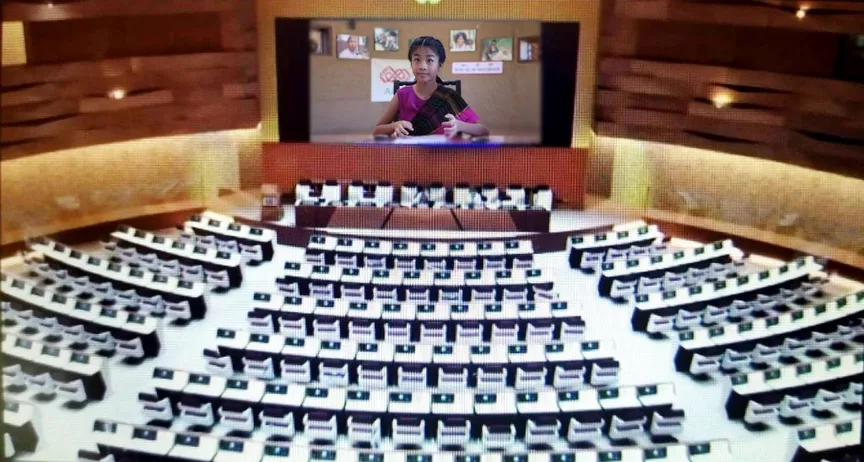
Respected Chair, on behalf of Asia IP Caucus, I, Cleopatra Tripura from Bangladesh would like to thank you for this opportunity to highlight the situation of Indigenous Children in Asia.
Indigenous Children are the most marginalized ones; their rights can be best understood by apprehending interconnectivity between children and community, culture and context, history of systematic discrimination and violation of Indigenous Peoples right. For Indigenous Children to enjoy rights under United Nations Convention on the Rights of the Child (UNCRC), recognition of Indigenous Peoples and their status is crucial. [1]
Indigenous Children are affected by land right violation which affects their health, development and survival inclusive of physical, intellectual, emotional and spiritual aspects.[2]
It is evident that Indigenous Peoples face greater barriers in accessing quality education; which is consistent from completion of primary education to higher level specifically for Indigenous girls.
Indigenous Child’s health is associated to structural risk embedded in political, historical, economic and social spheres. They have limited and inadequate access to health and sanitation services where poverty is one detrimental factor.
There is disproportionate numbers of Indigenous children and youth who are victimized by commercial sexual exploitation and human trafficking. They have become victim of worst forms of child labours in certain countries in South Asia and Southeast Asia.[3]
Militarization and armed conflict over Indigenous territories expose Indigenous Children to physical injury and death; torture and rape; atrocities; separation from parents and community; loss of access to health care, education and housing, eviction and forced displacement, and exclusion in humanitarian programs[4]. In September 2020, two children were killed by indiscriminate artillery fire in Rakhine state of Myanmar and there were 43 children killed and 103 injured in between January to June 2020 in Myanmar.[5]
Thereof, we urge EMRIP to highlight following recommendations with state for urgent action;
- Promote and protect of rights of Indigenous Children as outlined in UNCRC, constitutions and human right treaties.
- Recognize the rights to self-determination, land, territories and resources, and collectivism of Indigenous children and indigenous communities.
- Ensure equal and non-discriminatory access to health service, education and other basic services.
- Provide urgent protection against human right violations and sexual violation of Indigenous Children and youth in conflict zones like Myanmar, Philippines and Bangladesh.
- Initiate segregated data collection to monitor the situation of Indigenous Children and Youth facing child labour, trafficking, and access to basic services.
Lastly, we hope that these recommendations will be integrated in state’s priority actions.
Thank You.
Contact:
Cleopatra Tripura
C/O Charu Bikash Tripura, Bangladesh, on behalf of the Asia IP Caucus
Email: [email protected]
Click here to download the full statement
Watch the video of reading the statement here.
——————————————–
[1] Asian Indigenous & Tribal Peoples Network. The status of Indigenous and Minority Children and Bangladesh: A Submission to the UN Committee on the Rights of the Child on the Consideration of the Second Periodic Report of Bangladesh. New Delhi: AITPN, June 2003.
[2] Pinto, A., 2005. Inherit the Earth: indigenous Children’s Rights to Ancestral Lands: Trans-Generational, Comprehensive, Trans-National, Collective, International Indigenous Child Rights.
[3] Peter., 2003. Indigenous and Tribal Children: Assessing Child Labour and Education Challenges. Joint Working paper from the International Program on the Elimination of Child Labor and the INDISCO Program. Geneva. International Labor Organization.
[4] United Nations Children’s Fund (UNICEF). The State of the World’s Children 2006: Excluded and Invisible. New York: UNICEF, 2005.
[5] Human Rights Watch (HRW). Myanmar Events of 2020. https://www.hrw.org/world-report/2021/country-chapters/myanmar-burma. [Accessed on June21, 2021].
Contact Us
Asia Indigenous Peoples Pact (AIPP)
112 Moo 1, Tambon Sanpranate, Amphur Sansai, Chiang Mai 50210, Thailand
Phone: +66(0) 53 343 539
Fax: +66 (0) 53 343 540
[email protected]