EMRIP19: Agenda Item 7 – International Decade of Indigenous Languages
16 July 2026
19th Session of the UN Expert Mechanism on the Rights of Indigenous Peoples (EMRIP)
13th to 17th July 2026, Geneva, Switzerland
Joint Statement on
Agenda Item 7: International Decade of Indigenous Languages
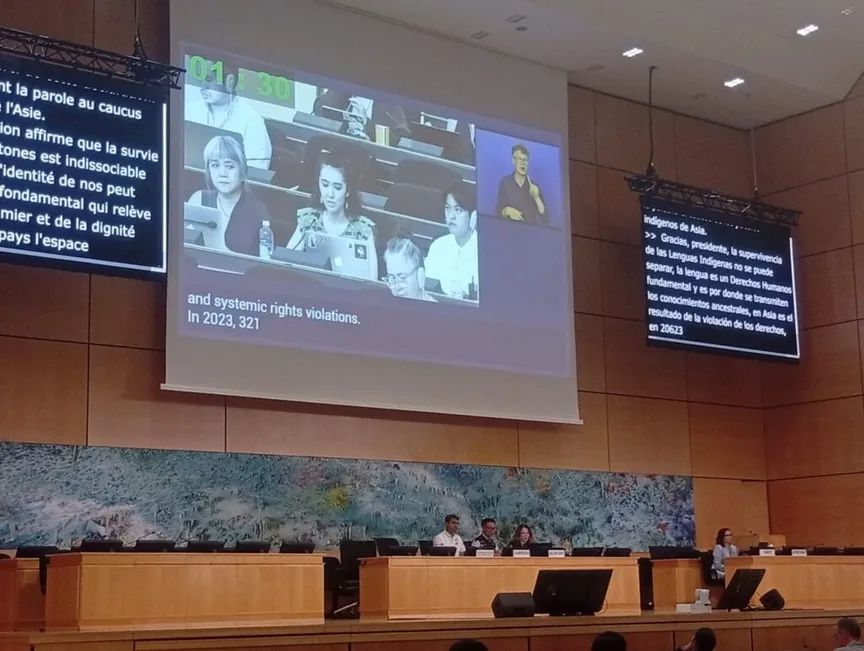
Presented by: Hazel Kuyama, on behalf of Asia Indigenous Peoples Caucus
Thank you Chair,
Asia Indigenous Peoples Caucus, affirms that the survival of Indigenous languages is inseparable from the survival of our peoples, cultures, and sovereign identities. Language is not merely cultural expression, it is a fundamental human right and the vessel of ancestral wisdom, customary law, and collective dignity.
In Asia, linguistic erosion is not a passive loss but the direct result of shrinking democratic space and systemic rights violations. In 2023 alone, 321 documented cases including land dispossession, criminalization, intimidation, and violence against women illustrate how assimilation policies dismantle the very structures needed for language survival.
In Malaysia, Indigenous organizations and their supporter[1] are using digital storytelling, animation, and Artificial Intelligence to revitalize Indigenous languages. These technologies are not replacing Indigenous knowledge, they are helping to bring it to life for the next generation through children’s stories, educational materials, and community-led digital content.
Indigenous Peoples are advancing data sovereignty through the Indigenous Navigator initiatives, enabling Indigenous community generated evidence to challenge state data and narratives. The Asian Framework on Indigenous Knowledge and Data Sovereignty (2023) is a milestone, ensuring oral traditions and spiritual knowledge are protected under community-controlled protocols.
We highlight successful initiatives such as Centres of Excellence in Village Governance in Malaysia and Thailand, and the documentation of customary laws in Indigenous languages. These initiatives prove that revitalization must be anchored in self-determination, territorial rights, and community‑led education.
We call on States and UN agencies to:
- Recognize and fund Indigenous Learning Centers and teachers.
- Protect territorial rights as the foundation of linguistic survival.
- Mandate Indigenous data sovereignty in monitoring.
- Adopt inclusive policies ensuring women, youth, and persons with disabilities lead this Decade.
Protecting our languages is protecting our future. We urge EMRIP to ensure this Decade delivers structural change, not symbolism.
Thank you.
Click here to download the full statement on EMRIP19 Item 7
————————————
[1] Kadazandusun Language Foundation, SIL International, Lotud Community Learning Centre, PACOS Trust, the Borneo Institute for Indigenous Studies, and Dayak Bidayuh National Association (BDNA)
Contact Us
Asia Indigenous Peoples Pact (AIPP)
112 Moo 1, Tambon Sanpranate, Amphur Sansai, Chiang Mai 50210, Thailand
Phone: +66(0) 53 343 539
Fax: +66 (0) 53 343 540
[email protected]