UNPFII25: Agenda Item 4 – Discussion on the six mandated areas of the Permanent Forum with reference to the United Nations Declaration on the Rights of Indigenous Peoples and the 2030 Agenda for Sustainable Development
24 April 2026
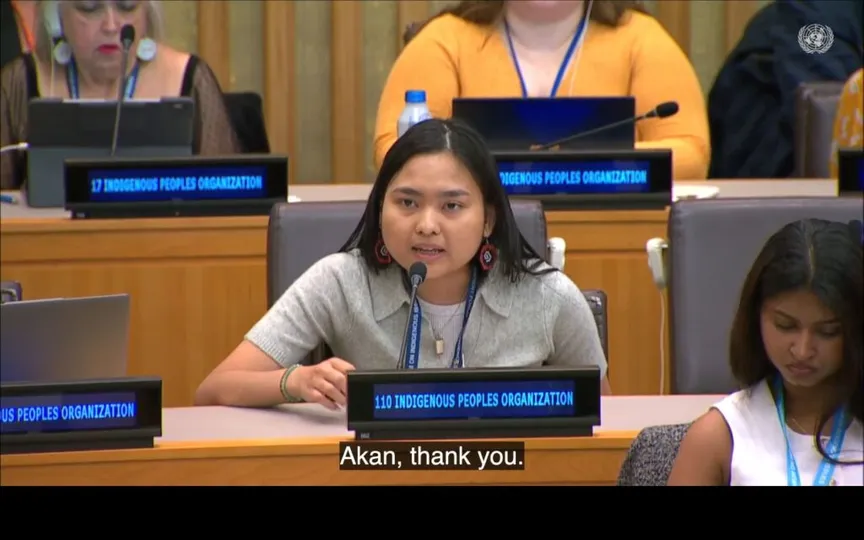
Joint Statement to the 25th session of the Permanent Forum on Indigenous Issues
Agenda Item 4 Discussion on the six mandated areas of the Permanent Forum (economic and social development, culture, environment, education, health, and human rights), with reference to the United Nations Declaration on the Rights of Indigenous Peoples and the 2030 Agenda for Sustainable Development
24 April 2026
Statement by: Asia Indigenous Peoples Caucus
Presented by: Emily Hang
Thank you, Madam Chair.
I am Emily Hang, on behalf of the Asia Indigenous Peoples Caucus, we commend the UNPFII for its comprehensive and insightful study on the impact of colonisation and armed conflicts on Indigenous Peoples’ rights. This work is a significant contribution to advancing understanding and action.
However, with respect, we wish to highlight some important limitations in the study’s framing. As we emphasised last year, while Frantz Fanon’s analysis revealed the psychological and structural violence of external colonialism and critiqued failures of revolutionary leadership, it did not fully address the enduring systems of internal colonialism imposed by dominant Indigenous groups—often existing long before foreign colonisation.
In contexts of militarisation and armed conflict, Indigenous Peoples’ fundamental rights—including sociocultural rights, the right to life, and control over lands and resources—are consistently violated. Situations across Bangladesh, Cambodia, the Philippines, Myanmar, Thailand, Vietnam, and the Ryukyu Islands highlight how historical injustices continue to drive Indigenous suffering, underscoring the urgent need for solidarity and sustained peacebuilding efforts to address root causes.
We emphasized that global commitments such as UNDRIP are important, but their impact depends on effective implementation, accountability, and recognition of Indigenous knowledge and lived realities. We also raised concerns about accessibility and inclusion within UN mechanisms, as barriers like visa restrictions, high costs, and limited support—especially for Indigenous persons with disabilities—continue to hinder meaningful participation.
Therefore, we reiterate our call to fully support the Permanent Forum’s recommendations and further urge the international community to:
- Consider rotating the UNPFII venue across different regions to enhance inclusivity and accessibility.
- Strengthen and ensure the meaningful participation of Indigenous Peoples in peacebuilding, governance, peacekeeping, and natural resource management.
- Fully implement the UNDRIP to uphold Indigenous self-governance and territorial rights, including across borders.
- Address and remedy violations of Indigenous Peoples’ rights in situations of armed conflict.
- Expand global research on internal colonialism and its impacts, and develop policy guidance to dismantle such structures and restore Indigenous sovereignty.
- Promote cross-border cooperation frameworks that support Indigenous governance over transboundary territories.
- Integrate Indigenous perspectives and territorial realities into UN systems—particularly in data collection, peacebuilding, development, and humanitarian efforts.
Thank you.
Click here to download the joint statement UNPFII25 Agenda Item 4
Contact Us
Asia Indigenous Peoples Pact (AIPP)
112 Moo 1, Tambon Sanpranate, Amphur Sansai, Chiang Mai 50210, Thailand
Phone: +66(0) 53 343 539
Fax: +66 (0) 53 343 540
[email protected]