UNPFII25: Agenda Item 5 (d) – Human rights dialogue with the Special Rapporteur on the rights of Indigenous Peoples and the Expert Mechanism on the Rights of Indigenous Peoples
22 April 2026
The 25th session of the UN Permanent Forum on Indigenous Issues
Agenda Item 5 (d): Human rights dialogue with the Special Rapporteur on the rights of Indigenous Peoples and the Expert Mechanism on the Rights of Indigenous Peoples; annual review of progress on the implementation of general recommendation No. 39 (2022) (Interactive dialogue)
22 April 2026
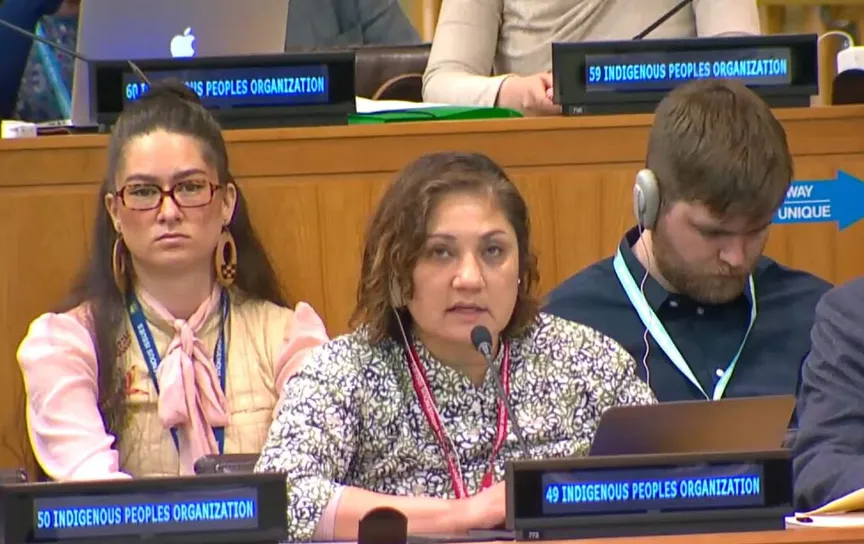
Statement by Network of Indigenous Women in Asia (NIWA)
Presented by Rinda Yamashiro
Thank you, Madam Chair.
My name is Rinda Yamashiro from Ryukyu Okinawa. I am speaking on behalf of Network of Indigenous Women in Asia (NIWA).
NIWA welcomes the engagement with the Special Rapporteur on the rights of Indigenous Peoples and EMRIP. We recognize their complementary mandates in advancing the implementation of the UN Declaration on the Rights of Indigenous Peoples.
We underline that the mandate of the UNPFII (Permanent forum) —to provide expert advice, promote awareness, and coordinate Indigenous issues across the UN system—must be strengthened through a gender-responsive approach that fully integrates the rights and realities of Indigenous Women, including Indigenous Women with disabilities and Indigenous persons of diverse gender identities, as well as girls.
As we review progress on CEDAW General Recommendation No. 39 (2022), we highlight persistent and intersecting forms of discrimination faced by Indigenous Women in Asia, particularly those with disabilities and those from gender-diverse communities, including legal invisibility, exclusion from governance, and barriers to land, justice, education, and health.
In this regard, NIWA offers the following key points:
* On UNPFII’s mandate (advisory and coordination role):
We urge the Forum to systematically integrate General Recommendation No. 39 into its advice to ECOSOC and UN agencies, ensuring that Indigenous Women’s rights are mainstreamed across all thematic areas, including land, climate, and development.
* On EMRIP’s mandate (implementation and technical advice):
We call on EMRIP to provide targeted technical guidance to States on implementing GR39 in alignment with the UN Declaration, including support for legal recognition of Indigenous Peoples and gender- and disability-responsive law and policy reforms that respect diverse gender identities.
* On human rights dialogue mechanisms:
We stress that engagement with the Special Rapporteur and EMRIP must ensure the meaningful, safe, and direct participation of Indigenous Women, including women with disabilities, gender-diverse Indigenous persons, and women human rights defenders, in all consultations and country engagements.
* On accountability and monitoring:
We encourage stronger collaboration between UNPFII, EMRIP, and CEDAW to develop joint indicators and monitoring frameworks that track States’ compliance with both the UN Declaration and GR39, including disaggregated data that captures disability status and gender diversity.
* On resources and access:
We call for increased direct funding and institutional support for Indigenous Women-led organizations including (those led by women with disabilities and gender-diverse Indigenous communities), to enable their sustained engagement with UN mechanisms and national implementation processes.
Finally, we urge States to engage in genuine human rights dialogue with Indigenous Women, in all their diversity, recognizing them not only as stakeholders, but as rights-holders and leaders.
The effectiveness of UNPFII (permanent Forum) and EMRIP will ultimately be measured by the extent to which Indigenous Women’s rights are realized in practice, including for those most marginalized due to disability and gender identity.
Thank you.
Click here to download the full statement UNPFII25 Agenda Item 5D
Contact Us
Asia Indigenous Peoples Pact (AIPP)
112 Moo 1, Tambon Sanpranate, Amphur Sansai, Chiang Mai 50210, Thailand
Phone: +66(0) 53 343 539
Fax: +66 (0) 53 343 540
[email protected]