UNPFII25: Item 5 (e) – Interregional, intergenerational and global dialogue
20 April 2026
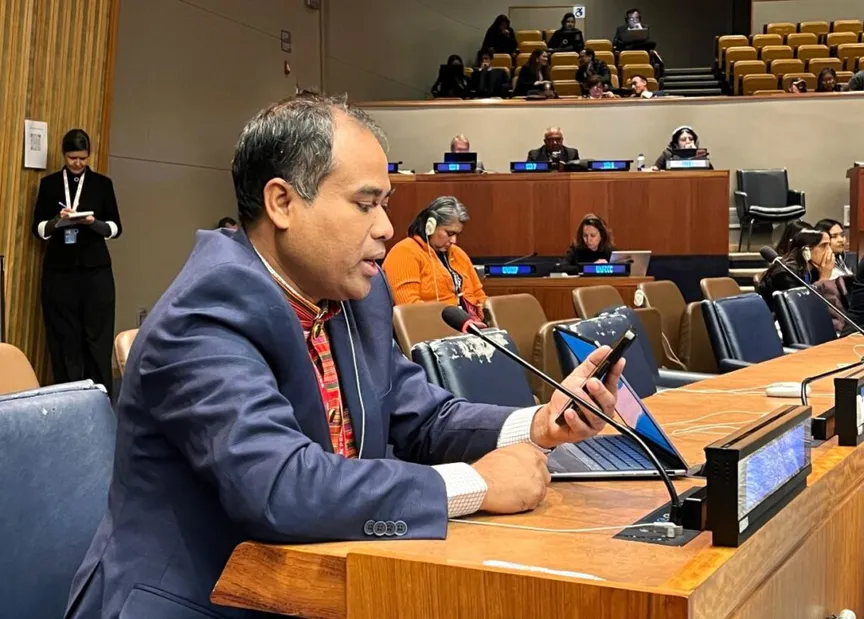
Statement to the 25th session of the Permanent Forum on Indigenous Issues
Item 5 (e): Interregional, intergenerational and global dialogue
Theme: “Indigenous Peoples and Climate Change: Articles 3, 4, 25 and 26”
20 April 2026
Statement by: Asia Indigenous Peoples Pact
Presented by: Shohel Chandra Hajang
Thank you, Madam Chair,
I am representing the Asia Indigenous Peoples Pact (AIPP). In this important dialogue, I would like to share key findings from the 2025 Indigenous Navigator Climate Change pilot conducted in Nepal and Bangladesh, implemented by AIPP in collaboration with the Danish Institute for Human Rights (DIHR), the Kapaeeng Foundation, and the Lawyers’ Association for Human Rights of Nepalese Indigenous Peoples (LAHURNIP). The pilot was carried out with the Gurung Indigenous community in Nepal and the Munda Indigenous community in Bangladesh. The European Union has already highlighted the Indigenous Navigator initiative; we thank them for their continued support for this important and effective tool to monitor the rights of Indigenous Peoples.
The findings highlight several serious gaps.
First, neither Nepal nor Bangladesh recognises Indigenous Peoples as distinct rights holders in climate change laws, policies, or governance structures. This reflects a wider gap between States’ human rights obligations under UNDRIP and their climate governance frameworks.
Second, Indigenous communities are already experiencing severe climate impacts. The Gurung community in Nepal faces flooding, landslides, shifting water sources, and farmland damage, while the Munda community in Bangladesh faces salinity intrusion, cyclones, tidal surges, sea level rise, and loss of traditional crops. These impacts directly threaten livelihoods and cultural practices, yet remain largely unaddressed in national climate policies.
Third, Indigenous Peoples are systematically excluded from climate decision-making and access to climate information due to language barriers, geographic isolation, digital exclusion, and inaccessible communication formats.
Fourth, climate and conservation measures are often implemented without Free, Prior and Informed Consent. Climate finance and social protection systems are also not responsive to Indigenous Peoples’ vulnerabilities.
In light of these findings, we present the following recommendations:
States must urgently amend climate laws and policies to explicitly recognise Indigenous Peoples’ collective rights in line with UNDRIP. Free, Prior and Informed Consent and Indigenous-specific impact assessments must be ensured for all climate actions, alongside legal recognition of customary and collective tenure, with safeguards against displacement and mechanisms for restitution and compensation.
Indigenous Peoples must be guaranteed meaningful participation in climate governance and access to culturally appropriate climate information. IPs knowledge systems and cultural integrity must be protected and integrated into adaptation and mitigation strategies.
Thank you.
Contact Us
Asia Indigenous Peoples Pact (AIPP)
112 Moo 1, Tambon Sanpranate, Amphur Sansai, Chiang Mai 50210, Thailand
Phone: +66(0) 53 343 539
Fax: +66 (0) 53 343 540
[email protected]