From Exploitation to Empowerment: Indigenous Rights and Leadership in Business and Climate Action
27 November 2025
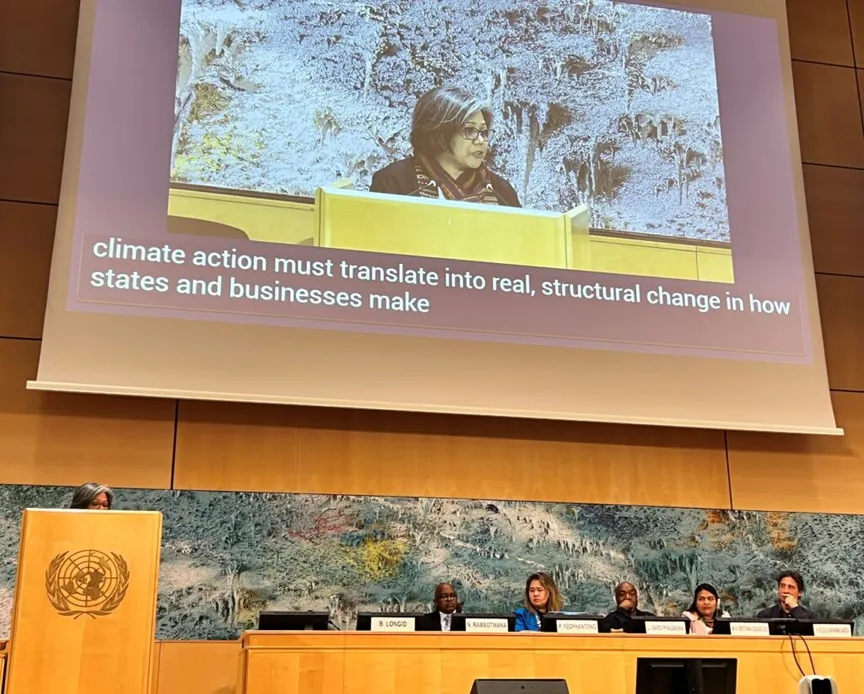
2025 United Nations Forum on Business and Human Rights
From Exploitation to Empowerment:
Indigenous Rights and Leadership in Business and Climate Action
Indigenous Peoples’ session | 25 November 2025
Presented by: Beverly Longid, Bontok-Kankanaey, Philippines and AIPP Chairperson
The growing recognition of Indigenous leadership in climate action must translate into real, structural change in how states and businesses make decisions—particularly where these decisions impact our lands, our livelihoods, and our futures. Indigenous Peoples are not simply stakeholders. We are rights-holders with self-determination, collective land rights, and governance systems that have sustained ecosystems long before today’s climate crisis.
First, states must fulfil their obligations under international human rights law.
This begins with legal recognition of Indigenous Peoples and our governance systems, customary laws, and decision-making institutions. Free, Prior and Informed Consent must be guaranteed and enforced as a mandatory requirement—not a procedural checkbox. FPIC must be led by Indigenous communities, with adequate information, time, and independent support, free from manipulation, militarization, or corporate influence.
States must also integrate FPIC, land rights, and self-determination into climate, environmental, and business regulations; adopt mandatory human rights and environmental due diligence; strengthen monitoring institutions; and ensure Indigenous Peoples have direct, meaningful participation in policy spaces—including climate transition planning, mining of critical minerals, carbon markets, and development strategies.
Second, businesses must move from a narrow compliance mindset to a genuine co-governance approach that respects Indigenous Peoples’ rights.
This means implementing Indigenous-specific due diligence designed with our communities; embedding our knowledge systems and science in project planning; ensuring well-resourced and accessible mechanisms for participation in risk identification, mitigation, monitoring, and remedy; and aligning all operations with UNDRIP, ILO 169, the Convention on Biological Diversity, and the UN Guiding Principles.
Risk management must also be reframed. For too long, companies have focused on the “risk of Indigenous resistance.” The real concern—and the ethical obligation—is the risk to Indigenous Peoples: cumulative cultural, environmental, social, and economic impacts, including those felt acutely by women, youth, and gender-diverse persons. Indigenous-led monitoring, mapping, and impact assessments must be central to any credible environmental or social due diligence system.
Third, both states and businesses must confront the structural drivers of harm.
Indigenous communities continue to face land grabbing, forced displacement, militarization, criminalization, and attacks on our human rights defenders—often justified in the name of “clean” or “green” energy. Climate action cannot become a new front of dispossession. We welcome the decision of the UN Working Group on Business and Human Rights to produce a dedicated report on Indigenous Peoples, FPIC, and business activities—an urgent and necessary step.
Fourth, recognition must be matched with participation. States and businesses should establish permanent, properly resourced mechanisms for Indigenous representation in policymaking bodies, corporate accountability platforms, climate transition processes, and monitoring of business conduct. These spaces must be free from intimidation and accessible to Indigenous communities across regions.
Finally, accountability must be real. This means independent investigations into abuses, sanctions for violations, and effective remedies for communities harmed by state or corporate actions. Protecting Indigenous human rights defenders is essential—because without safety, participation is impossible.
And beyond remedy, we call for direct partnership with and investment in Indigenous-led climate solutions, conservation, and sustainable livelihoods. Our protection practices have already proven effective in safeguarding biodiversity and strengthening resilience. Supporting Indigenous Peoples is not charity; it is necessary for achieving global climate, environmental, and human rights goals.
Colleagues, if the world truly recognizes Indigenous leadership, then it must respect our rights, uphold FPIC, end the harms, and invest in Indigenous-led solutions. Protecting our mountains, forests, and waters is both a moral imperative and a path to real climate justice.
Indigenous Peoples stand ready to contribute our leadership, our knowledge, and our solutions. We are not obstacles to development. We are partners—if states and businesses are ready for partnership grounded in rights, justice, and self-determination.
Thank you.
Contact Us
Asia Indigenous Peoples Pact (AIPP)
112 Moo 1, Tambon Sanpranate, Amphur Sansai, Chiang Mai 50210, Thailand
Phone: +66(0) 53 343 539
Fax: +66 (0) 53 343 540
[email protected]