Closing Statement delivered at the UN Responsible Business and Human Rights Forum, Asia- Pacific
19 September 2025
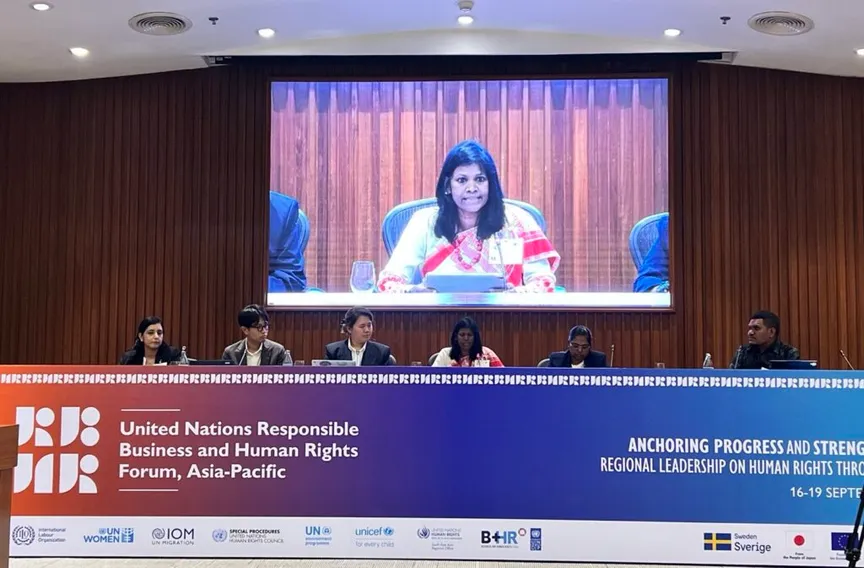
Closing Joint Statement
Asia Indigenous Peoples Caucus
7th United Nations Responsible Business and Human Rights Forum, Asia-Pacific
19 September 2025, UN Conference Center (UNCC), Bangkok, Thailand
Distinguished delegates, my indigenous fellows, and friends,
Johar, my warm Indigenous greetings!
I speak on behalf of the Asia Indigenous Peoples Caucus, and I would like to thank the UN Voluntary Fund for supporting my participation.
As we close this Forum, we honor the courage of rights-holders and civil society who have been here since day one. This space has given us the opportunity, despite challenges, to bring forward the lived realities, struggles, and aspirations of Indigenous Peoples across Asia and the Pacific.
Throughout the discussions, one message has been constant and clear: We, Indigenous Peoples, demand respect for our rights to lands, territories, and resources; recognition as rights-holders; and genuine participation in decisions that shape our futures.
Again and again, we have heard the voices of indigenous communities calling for accountability, stronger protections, and an end to harmful business practices that drive dispossession, displacement, and violence. We highlight just a few examples:
- In Northeast and mainland India, oil exploration, carbon market projects, forest and biodiversity conservation initiatives advance without Free, Prior, and Informed Consent.
- In Thailand, the Omkoi coal mining project moves forward despite manipulated EIA processes.
- In Indonesia, the Cek Bocek/Selesek Reen Sury Indigenous Peoples of Sumbawa face mining expansion overlapping with the Elang Project, desecrating ancestral graves and sacred sites.
- And in West Papua, Indigenous Peoples are facing a slow genocide systematically conducted through violence, forced evictions, and massive deforestation linked to extractive industries and government “national strategic projects.” For Papuans, forests are not mere resources but Mother. Their destruction brings deep trauma, threatening both culture and survival.
These examples remind us: if we remain silent, we all become complicit in crimes against humanity and against the environment.
Over the past days, we have heard commitments to responsible business and human rights. But for Indigenous Peoples, these are not abstract ideals—they are life-and-death realities. After more than a decade of the UN Guiding Principles, voluntary measures like National Action Plans remain insufficient. States continue to backslide, businesses pursue “business as usual,” and Indigenous Peoples continue to bear the heaviest costs. Our right to FPIC is too often ignored while extractive projects and false climate solutions expand under the name of development and transition.
Yet Indigenous Peoples are not only raising alarms—we are offering solutions. As the world speaks of just transitions, we remind everyone: there can be no just transition without Indigenous rights. Our governance systems, knowledge, and stewardship of lands, territories, and waters are central to biodiversity, climate resilience, and sustainable futures.
If this Forum is to have meaning, words must turn into action:
- Businesses must respect FPIC, conduct genuine human rights and environmental due diligence, and provide effective remedies.
- States must align laws and policies with the UN Declaration on the Rights of Indigenous Peoples, move beyond voluntary commitments, and adopt binding measures that ensure accountability.
- Donors and financial institutions must fund Indigenous-led initiatives directly and withdraw support from harmful projects.
Above all, States, businesses, and financial institutions must work in true partnership with Indigenous Peoples, recognizing our knowledge, wisdom, and leadership. Protecting our rights is not only a legal duty—it is the pathway to protecting our shared future on this planet.
A just and sustainable future is only possible when our demands are not only heard but acted upon—through concrete measures that reach the ground, where Indigenous communities live and struggle. This must include sustained capacity building that strengthens Indigenous Peoples’ ability to exercise our rights and lead our own solutions.
Thank you.
Contact Us
Asia Indigenous Peoples Pact (AIPP)
112 Moo 1, Tambon Sanpranate, Amphur Sansai, Chiang Mai 50210, Thailand
Phone: +66(0) 53 343 539
Fax: +66 (0) 53 343 540
[email protected]