Asia Indigenous Peoples Pact Calls for Urgent Stop to Airstrikes and Protect Civilians in Thailand-Cambodia Border Conflict
25 July 2025
Asia Indigenous Peoples Pact Calls for Urgent Stop to Airstrikes and Protect Civilians in Thailand-Cambodia Border Conflict
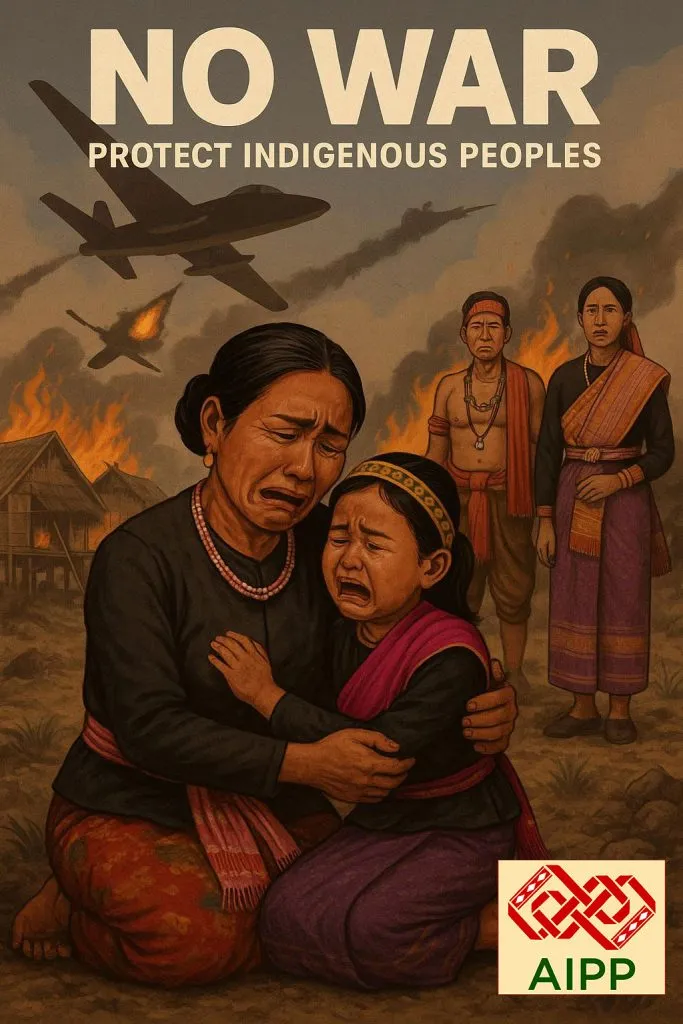
The Executive Council of the Asia Indigenous Peoples Pact (AIPP) strongly urges an immediate halt to the airstrikes and exchanges of fire carried out by both the Thai and Cambodian militaries on July 24, 2025. These hostilities have severely endangered civilian populations and escalated the conflict along the Thailand-Cambodia border.
We are deeply concerned by the loss of life, injuries, and destruction of homes and property caused by these attacks. Indigenous Peoples living in the border regions, especially women and children are among the most affected. These communities already face marginalization and are now more vulnerable due to the conflict. The use of airstrikes directly puts civilians in harm’s way and breaches the principle of protecting civilians.
We call on both governments to immediately stop all military actions, especially the use of airstrikes and open fire near civilian areas, and to take swift and concrete steps to de-escalate tensions. Continued hostilities risk developing into a full-scale conflict that could cause irreparable harm to both Thai and Cambodian citizens—particularly Indigenous Peoples who have long inhabited and safeguarded these territories.
Border communities, many of whom are Indigenous, now face threats of displacement, loss of traditional lands, and disruption to their cultural and spiritual lives. Past conflicts in the region have shown that Indigenous Peoples are often among the first to be displaced, the last to receive humanitarian aid, and the most neglected in recovery efforts. Previous clashes have forced communities to flee, seeking refuge in overcrowded camps or becoming internally displaced persons (IDPs) within their homelands, torn from the very land that sustains their identity and livelihoods.
We urge the governments of Thailand and Cambodia to:
- Immediately stop all military actions and avoid further use of airstrikes and artillery in populated areas.
- Engage in meaningful and peaceful dialogue to resolve territorial disputes and prevent further escalation.
- Ensure protection and humanitarian support for all affected civilians, especially Indigenous communities along the border.
- Facilitate the safe return and rehabilitation of displaced persons, and uphold the land rights and cultural integrity of Indigenous Peoples.
We appreciate the effort of Prime Minister of Malaysia to mediate the situation, and call on all governments in Asia to support this Initiative.
AIPP reaffirms that sustainable peace and security in the region can only be achieved through inclusive, diplomatic, and rights-based solutions. We stand with the affected communities and call on all parties to uphold human rights, respect Indigenous Peoples’ rights, and prevent a worsening humanitarian crisis.
Executive Council Members of AIPP
| No. | Name | Sub-Region/Position |
| 1 | Gam A. Shimray (M) | Secretary General |
| 2 | Beverly L. Longid (F) | Chairperson |
| 3 | Venedio Nala Ardisa (M) | Youth Representative |
| 4 | Yun Mane (F) | Women Representative |
| 5 | Jagat Baram (M) | South Asia |
| 6 | Mina Kumari Ekka (F) | South Asia |
| 7 | Pallab Chakma (M) | South Asia |
| 8 | Hean Bunhieng (M) | Mekong |
| 9 | Nittaya Earkanna (F) | Mekong |
| 10 | Abdon Nababan (M) | Southeast Asia |
| 11 | Hellan Empaing (F) | Southeast Asia |
| 12 | Su Hsin (F) | East Asia |
Click here to download the full statement
List of Endorsements
Contact Us
Asia Indigenous Peoples Pact (AIPP)
112 Moo 1, Tambon Sanpranate, Amphur Sansai, Chiang Mai 50210, Thailand
Phone: +66(0) 53 343 539
Fax: +66 (0) 53 343 540
[email protected]