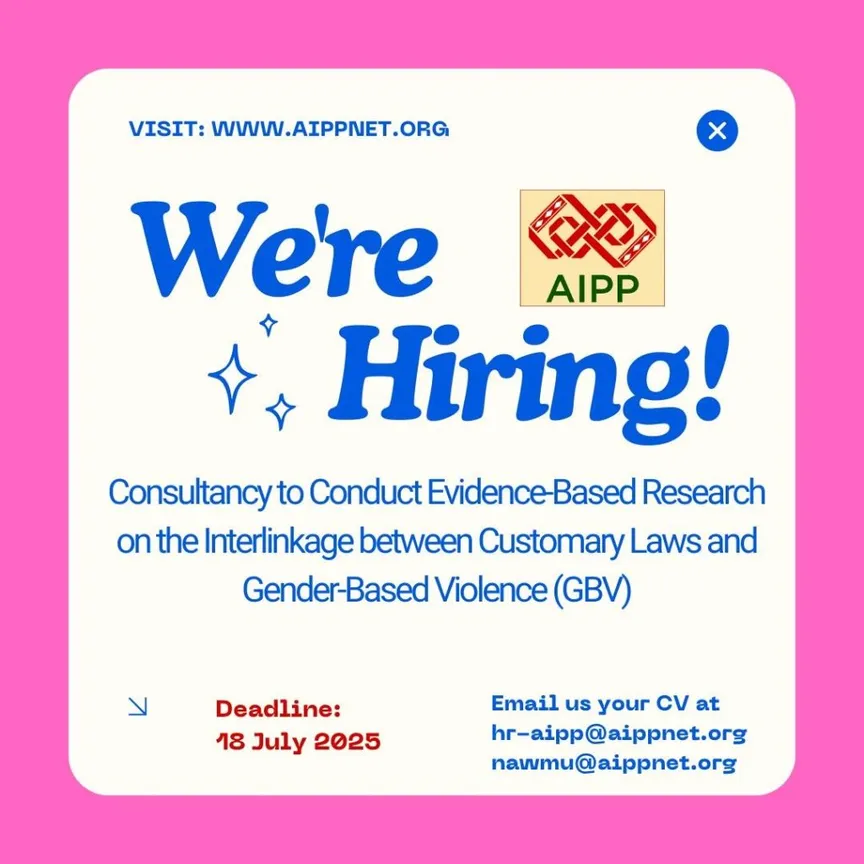
Call For Expression of Interest: Consultancy to Conduct Evidence-Based Research on the Interlinkage between Customary Laws and Gender-Based Violence
25 June 2025
:
:
:
1. Background
Asia Indigenous Peoples Pact Foundation (AIPP) was founded in 1988 and established its Secretariat Office in Thailand with the conduct of its first General Assembly in 1992. At present, AIPP is described as an organization of Indigenous Peoples’ movements in Asia with 47 member organizations and 1 candidate member organization from 14 countries. It is primarily set up to build solidarity on common issues and concerns as well as to create a shared vision of Indigenous Peoples in the region. The steady growth of AIPP over the years reflects not only the growing recognition of AIPP as an organization addressing Indigenous Peoples’ needs and aspirations, but the growing self-identification of marginalized groups in Asia as Indigenous Peoples, which they see as a way to overcome discrimination and counter the violation of their individual and collective human rights and to realize their right to self-determination.
As part of its continued commitment to advancing gender equality and strengthening the rights of Indigenous women, the Indigenous Women Programme (IWP) of the Asia Indigenous Peoples Pact (AIPP) is initiating a comprehensive research study to explore the complex and often under examined relationship between customary laws and gender-based violence (GBV) within Indigenous communities. Recognizing that customary laws play a significant role in shaping social norms, conflict resolution mechanisms, and gender relations in many Indigenous societies, this research aims to unpack both the protective aspects and the potentially discriminatory or harmful dimensions of these customary legal systems in the context of GBV.
Through this study, AIPP seeks to deepen its understanding of how customary laws influence the lived experiences of Indigenous women and girls—whether by reinforcing patriarchal practices or by serving as tools for justice and protection. The research will generate evidence-based insights that reflect community realities and Indigenous women’s voices, contributing to the broader discourse on gender justice, and cultural rights.
Ultimately, the findings from this research will support targeted advocacy, community engagement, and policy dialogues at local, national, and regional levels. It will provide a basis for developing culturally appropriate and rights-based recommendations to help harmonize customary legal practices with international human rights instruments, such as the Convention on the Elimination of All Forms of Discrimination Against Women (CEDAW) and the United Nations Declaration on the Rights of Indigenous Peoples (UNDRIP), particularly in addressing and preventing GBV within Indigenous contexts.
2. Objectives of the Consultancy
The overall objective of the consultancy is to generate evidence-based findings on the relationship between customary laws of Indigenous Peoples and GBV, focusing on both protective and harmful practices. Specific objectives include:
-
Identify and examine customary laws and practices through a gender lens, particularly in relation to gender roles, conflict resolution, and family-related matters.
-
Evaluate how these customary laws and practices either contribute to or help address and prevent GBV.
-
Capture and reflect Indigenous women’s lived realities and perspectives regarding customary laws and GBV.
-
Offer practical recommendations for actions at both the community and policy levels.
3. Scope of Work
The consultant will be responsible for:
-
Reviewing existing literature and research on the customary laws of Indigenous Peoples and their connection to gender-based violence (GBV).
-
Developing research framework, tools and present the analysis framework to AIPP for inputs
-
Carrying out field-based data collection, in collaboration with local partners where relevant.
-
Consulting with Indigenous communities, including women, elders, youth, and other key stakeholders.
-
Developing a comprehensive research report with key findings, case studies, and actionable recommendations.
4. Deliverables
Based on the above, the key deliverables are as follows:
-
Inception report: A detailed work plan outlining the proposed research methodology, tools, and timeline.
-
Draft research report for review.
-
Final research report (including executive summary and recommendations).
5. Consultant Qualifications
The consultant(s) should possess the following competencies:
-
Proven experience, skills, and experience in conducting research on gender, and GBV.
-
Demonstrated experience in working with Indigenous Peoples Organizations, particularly Indigenous Women Organizations and Networks, and familiarity with Indigenous knowledge, values, and practices.
-
Knowledgeable about the Indigenous Peoples and Indigenous Women’s movements in Asia and beyond.
-
Relevant work experience, expertise and knowledge in Gender Equality, Diversity, and Social Inclusion (GEDSI) with an Intersectionality approach.
-
Knowledge on qualitative and/or mixed-method research skills.
-
Experience in participatory, rights-based, or feminist methodologies is highly desirable.
-
Excellent analytical and writing skills.
6. Reporting
The consultant(s) will report to AIPP’s Indigenous Women Programme for guidance, quality assurance, and finalization of deliverables.
7. Location
This assignment will be remote-based assignment, with travel required for community visits to conduct data collection, as agreed upon in consultation with the IWP team and outlined in the proposal. All logistical arrangements and costs associated with the approved field visits—such as transportation, accommodation, and per diem—will be fully covered by AIPP, in accordance with its internal travel and finance policies. The consultant is expected to coordinate closely with the IWP team for planning travel schedules, community access, and local support during the visits.
8. Payment
The payment will be structured as follows:
-
30% of the total amount will be paid upon acceptance of the inception report.
-
50% will be paid following the submission of the draft research report.
-
The final 20% will be paid upon the successful and satisfactory completion of all deliverables as specified in the contract.
9. Duration
The duration of the consultancy agreement will be 90 days from the date of signing the contract.
10. How to Apply
To apply for the consultancy position, interested consultant(s) should send the following documents to [email protected] and [email protected] by July 18, 2025.
-
Cover Letter: An overview of the applicant’s understanding of the assignment, relevant experience, and qualifications of the team members or individual involved.
-
Technical Proposal: A detailed approach and methodology for conducting the research, including a work plan and timeline.
-
Financial Proposal: A budget breakdown outlining the cost of the consultancy, including professional fees and any other expenses.
-
CVs/Profiles: CVs of the consultant(s) or a profile of the firm, highlighting relevant experience and expertise.
In the email subject line, please mention: AIPP/Gender Research
Only shortlisted Consultant(s) will be notified.
Click here to download the full EOI for Consultation EBR, GBV
Share this post
Contact Us
Asia Indigenous Peoples Pact (AIPP)
112 Moo 1, Tambon Sanpranate, Amphur Sansai, Chiang Mai 50210, Thailand
Phone: +66(0) 53 343 539
Fax: +66 (0) 53 343 540
[email protected]