UNPFII24: Exploring Multiple Pathways Towards the Realization of Self-Determination for Indigenous Peoples in Asia, presented by Shinako
24 April 2025
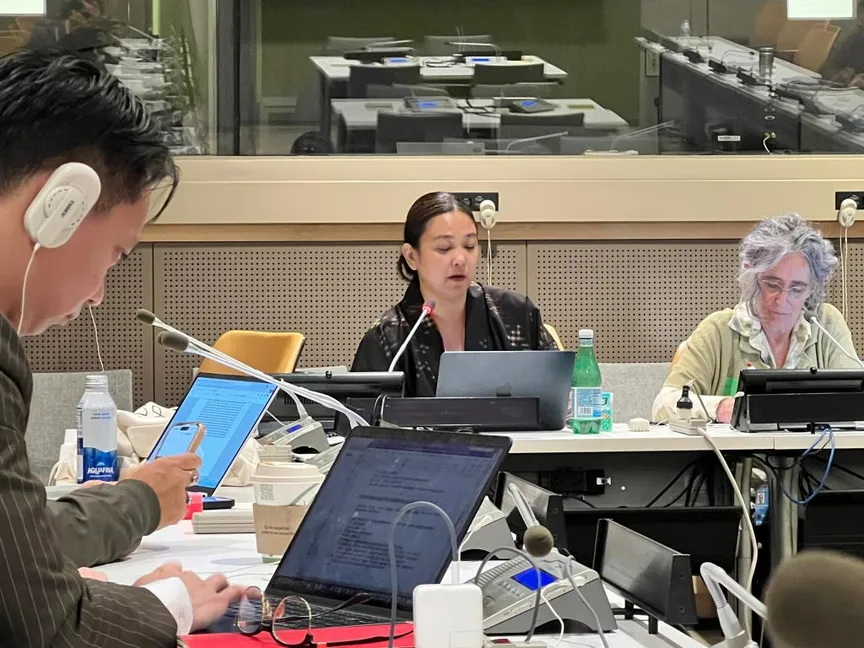
Haisai, My name is Shinako Oyakawa, and I am an Indigenous Ryukyuan. I live in Okinawa, Japan. While I serve as a co-representative of ACSILs, today I am speaking on behalf of NIWA, the Network of Indigenous Women in Asia, of which our organization is a member.
The Network of Indigenous Women in Asia (NIWA) was established in 2019 with backing from the Asia Indigenous Peoples Pact (AIPP). Asia is home to an estimated 260 million Indigenous Peoples, and roughly half of them are women. Our human rights and access to justice are deeply connected to our identity as Indigenous peoples—particularly our rights to land, territories, and resources, which are often at the center of the violations we face.
NIWA is a collective of Indigenous Women’s organizations from 10plus countries across Asia. It operates with a strong mission: to support Indigenous Women by advocating for our political, environmental, and socio-economic rights. Through collaboration and network-building, NIWA helps amplify voices that are often marginalized. Participants of the Regional Indigenous Women Exchange recognized the importance of having a regional platform to enhance visibility, solidarity, and advocacy while navigating the long-term challenges of funding and sustainability.
NIWA’s core work centers on three areas: 1) IW movement building and strengthening
, 2) Land rights and Natural Resource Management (including climate change, Indigenous Knowledge, biodiversity conservation) and 3) Indigenous Women in Decision Making
. Regional exchange programs, like the 2024 gathering held in the Philippines, are vital in nurturing alliances, sharing knowledge, and reinforcing the collective effort toward land justice and community empowerment.
At the exchange, delegates shared the unique but interconnected struggles faced in our homelands. For example my sister, Rinda Yamashiro, spoke about Okinawa, once the independent Ryukyu Kingdom, which was forcibly annexed by Japan in 1879. The people of Ryukyu/Okinawa still live under systemic discrimination, worsened by the heavy U.S. military presence.
It is now clear that there is an unspoken agreement between the US and Japan to covering up incidents of sexual violence against Ryukyuans, especially women and girls, by US military personnel that have been going on since the US military landed in Okinawa until now, without having to notify Okinawa Prefecture. Two more cases were revealed yesterday, and these are often young women and girls who are targeted. To report sexual crimes to police is not easy things to do for Asian Indigenous women in terms of Patriarchy, Social prejudice against victimized women and so on, and the arrest rate for crimes committed by U.S. military personnel is very low, and there is an unequal status of forces agreement that 90% of those arrested are not prosecuted. Currently, we do not even know how many cases of sexual violence are derived from U.S. military bases. This deprives us of the opportunity to provide physical and mental health cares for indigenous women and girls, to supports their court cases, and even to speak out on their behalf and work to prevent recurrence and resolve the base issues.
Issues like gender-based violence, accidents, and other social harms persist, making it clear that local efforts alone are not enough. Becoming part of NIWA allowed us to reach out beyond our immediate community—gaining knowledge, support, and opportunities like youth participation in workshops.
Across Asia, Indigenous Women face shared challenges: lack of recognition, educational inequality, limited job access, violence against women and girls, state neglect of health care, and land-related oppression. At the exchange, we agreed that Indigenous Women and our communities must stand united against harmful state-led projects. We also emphasized the need for young people to reconnect with their roots and help carry on traditional culture—using tools like social media to tell our stories and preserve their heritage.
We are going to have our General Assembly meeting next months and I am going back my wonderful experience and effort we met in this PFII and contribute for our Indigenous sisters in ASIA.
Contact Us
Asia Indigenous Peoples Pact (AIPP)
112 Moo 1, Tambon Sanpranate, Amphur Sansai, Chiang Mai 50210, Thailand
Phone: +66(0) 53 343 539
Fax: +66 (0) 53 343 540
[email protected]