
Life Practices Entangled with Mukkumlung: The Yakthung Connection to Nature and Sacred Beliefs
26 March 2025
Sirjana Subba, Kathmandu, Nepal
The ongoing #NoCableCar movement at Mukkumlung (Pathivara) is often perceived as opposition to development; however, it is deeply connected to the beliefs, culture, faith, and life practices of the Yakthung/Limbu Indigenous Peoples.
A conflict has been ongoing for the past few months between those in favor of constructing a cable car and those opposing it at Mukkumlung (Pathivara), a sacred site. Rather than reaching a resolution, the conflict continues to escalate. The question remains: why are people so strongly opposed to the construction of the cable car?
Let me start with an example of “four pests control” campaign (1958-1962) of China implemented by Mao Zedong. For this campaign they planned to kill sparrow, mouse, fly and mosquito in order to get good harvest and prevent people from getting sick. In contrary, crop production reduced, and people have to face huge famine. Due to famine, in the period 1959 to 1961 almost 23-30 million people lost their lives.
This incident is known as the “Great Chinese Famine.” The excessive killing of birds, insects, and animals disrupted the natural balance, leading to a decrease in crop production. It serves as a cautionary example of how the destruction of nature does not lead to development.
Now, let’s explore why the Yakthung/Limbu Indigenous Peoples are so strongly opposed to the construction of the cable car. For them, the mountain is sacred, as per their Mundhum and belief system, and they are willing to die in defense of it. One example of this deep connection is their belief regarding grain-eating birds.
The Yakthung Indigenous Peoples believe they should not drive away birds while they are eating crops. According to their Mundhum and folktales, birds played a crucial role in bringing seeds for agriculture. As a gesture of gratitude, the Yakthung Indigenous Peoples promised not to chase the birds away, even if they ate their crops. This story is embedded in the origins of the Yalang dance (Dhan-nach in Nepali). As a result, the Yakthung people continue to allow birds to eat their crops and refrain from driving them away.

Yakthung men and women participating in yalang dance Photo source: https://khabarhub.com/2023/02/546207/
In Yakthung Mundhum, there are various anecdotes about animals such as porcupines, mice, birds, monkeys, eagles, and dogs helping humans. Similarly, the Phaktimba (owl) is regarded as the wisest bird, known for its strong sense of justice. Due to its ability to see in the dark, it is believed that no one can hide anything from Phaktimba.
There is another story related to nature. Kesamai and Namsami were two sons of Ipnaso Saranghangma (or Ipnaso Sarangthangna)—one a tiger, the other a human. While it may seem impossible for a woman to give birth to both a tiger and a human, they symbolize nature and culture. Nature is wild, free, and untamed, while culture is civilized, controlled, and full of values. Though they may seem opposites, they are both children of the same mother and are interdependent on one another.
Stories from the Mundhum illustrate the complementary relationship between humans and nature. It is believed that every living organism has a role to play. For example, earthworms and snakes help maintain the soil, and therefore, it is forbidden to kill them. Before chopping down a tree, forgiveness is asked, and afterward, two saplings of the same variety must be planted in its place. It is also prohibited to whistle or make noise in the jungle at night, as it is believed that the forest goddess, Tambhungna, will become angry. Tambhungna protects the forest and its animals. These beliefs were created to safeguard animals, birds, and nature.
It is important to worship the hunter gods and the forest goddess, Tambhungna, before going on a hunt. It was mandatory to ask for forgiveness for taking an innocent life and to promise to take only what is necessary. The Yakthung people continue to follow the moral code outlined in the Mundhum.
Similarly, in the Naawaa Chai:t Mundhum, or the Mundhum of creation, there is another fascinating story. God Porokmi Yombhamiba created the earth, stone, soil, air, water, aquatic animals, land animals, plants, and more. Then, the creator god wished to create a perfect human being, endowed with all virtues and immortality. He first made a human from clay and stone, but the human was too small to even carry a goat’s dung. The god realized that such a small being could not enjoy, manage, or protect nature, so he ordered them to be “Khambongba-Lungbongba,” the stewards or caretakers of the land. This is why the Yakthung community believes they are not the owners of the land, but rather “Khambongba-Lungbongba.” Therefore, land is not seen as a commodity that can be sold or bought. Historically, land—comprising jungle, fields, and water—was communal property among the Yakthung under the Kipat[1] system.
However, this communal property was transformed into private property after the implementation of the Land Reform Act of 1964. From that point on, land became a commodity that could be bought and sold for cash.
According to the Mundhum, Porokmi Yombhamiba attempted to create a human from precious stones and metals like diamond, ruby, gold, and silver. However, none of the humans made from these precious materials had a soul. Then, the supreme goddess Tagera Ningwaphu Mang appeared to him in a dream and suggested creating humans using a mixture of ash, bird droppings, and bamboo water. Following her guidance, Porokmi Yombhamiba created a human and ordered, “Oh human, speak.” To the god’s surprise, it responded, “Yes.”
The god became frustrated, as the humans made from precious materials did not speak, but the one made from bird droppings and ash did. Looking at the human made of ash and bird droppings, he spat and muttered, “Damn it.” Upon hearing these words, the human’s “sheer dhalxa” (literally meaning “lost head,” which is similar to “lost face”) and died. Seeing the dead human, Porokmi Yombhamiba became frightened and prayed to Tagera Ningwaphu Mang. She appeared to him in a dream and instructed him to perform the Mangenna[2] ritual to “raise the head high.”

A Phedangma (Yakthung priest) performing Mangenna ritual of a man
Photo source: Social media
After performing the ritual, the human came to life again. Thus, “seer uthaune” or “raising the head high” holds great meaning and importance within the Yakthung community. It is both a ritual performance and a conflict management tool used to maintain peace and harmony in society. Additionally, it is viewed as a process to reach “Cho?lung.” According to Dr. Chaitanya Subba, “Cho?lung” is “the highest accomplishment of life that humans should strive for” and “an alternative to the perishability, decay, and transience of human life bestowed by the creator God.” In other words, those who reach “Cho?lung” attain immortality.
At the end of the Naawaa Chai:t Mundhum, Porokmi Yombhamiba creates mortal humans who are more knowledgeable and wiser than other animals. He then orders humans to enjoy, maintain, and protect his creations. However, humans not only inherit knowledge and wisdom from their creator but also envy, anger, and a sense of possession. This is reflective of the creator god’s initial disdain for his own creation.
An elaborate description of envy and jealousy can be found in the Nahen Mundhum. This Mundhum explains that greed, anger, and evil all stem from envy. As a result, humans often desire more than they need, become jealous of their relatives and neighbors, and act maliciously to fulfill their greed. It is believed that such behavior will not lead people to Cho?lung and will harm society.
To manage this, the Yakthung perform the Sakmura Wademma ritual (commonly known as “gali-sarap bagaune” in Nepali) to ward off evil eye. Each family goes to the river to wash away the evil thoughts or words they have received from others, and vice versa. In this way, they cleanse their minds and souls, helping them avoid greed and learn to be content with what they have.

Yakthung performing Sakmura Wademma (commonly known as “gali-sarap bagaune” in Nepali) ritual to ward off evil eye and cleanse their minds and souls.
Photo source: Social media
There is a Mundhum that provides guidance on the construction of a house, teaching the proper selection of timber to prevent termite damage. The Yakthung, who possess this knowledge of house-building, did not construct temples or religious shrines. Why?
For the Yakthung, the forest, jungle, rivers, creeks, hills, and mountains are all considered the dwelling places of gods. Phaktlung (Mt. Khumbhakarna), Chamchamlung (Mt. Kanchanjunga), Manchhayam, and Mukkumlung (Pathivara) are all sacred mountains. Similarly, water sources such as the Tamor River, Kabeli River, Mai River, Timbung Lake, and Mai Lake are considered the abodes of the water goddess “Warakma.” Therefore, there is no need for them to construct physical structures to honor these sacred places.
When the Yakthung worship their gods, such as Yumasam (the grandmother god), Thebasam (the grandfather god), Himsam (the house god), and various clan gods, they use stones as symbols for these deities. After the ritual is performed, they return the stones to the soil from which they were taken. They take from nature and give back to nature once their use is complete. Even in their regular home worship, they use simple offerings like mugwort/wormwood, cut flowers in a vase, and lit lamps or incense,
Additionally, during their greatest festival, Chashok, the Yakthung not only offer new harvests to the gods but also ask for forgiveness from the animals and insects that may have been harmed, either intentionally or unintentionally, during farming. Thus, every year during Chashok, the Yakthung not only thank the gods but also express gratitude towards all the animals and insects that contributed to the harvest. These practices and beliefs reflect the Yakthung’s deep connection with nature.

A Yakthung man offering new harvested crops to various gods and goddess duing Chashok festival
Photo source: https://sekmurifoundation.com/chasok-tangnam/
Some Yakthung refer to their religion as Kirat, while others call it Yuma. Upon closer examination, it becomes clear that it is a nature-worshipping religion. The core purpose of this religion is to worship and protect nature. It holds the belief that everything created naturally has a soul, and to harm nature is considered an act of injustice.
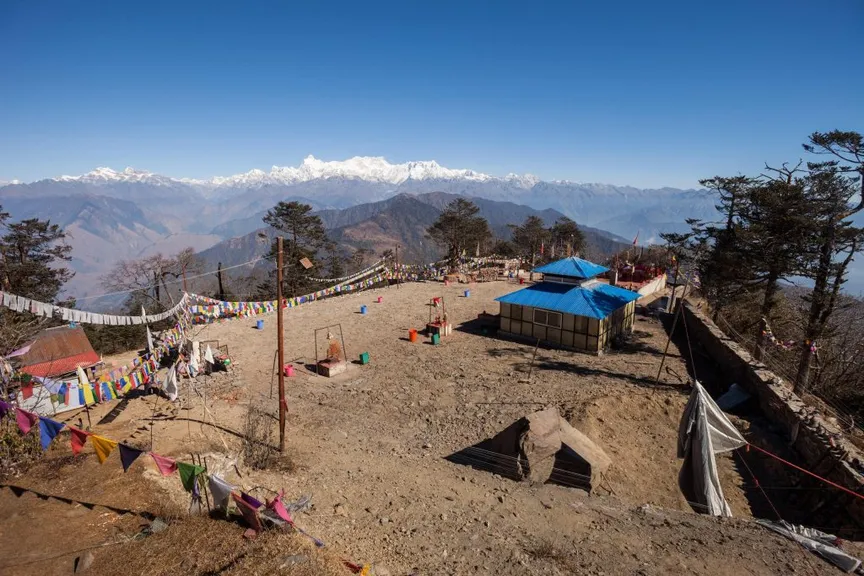
Currently, the sacred mountain located in Eastern Nepal is in turmoil. The mountain is known by several names, including Semuktu Muti Kokma, Muktubung, Mukkumlung, and Pathivara. Each of these names has significance in the Yakthung culture, all of which are associated with fire or power. In every civilization, fire holds a special place. Fire is not only a form of physical energy but also symbolizes supernatural energy. This is why Mukkumlung is believed to possess the energy (or power) to fulfill the wishes of those who visit it.
When visiting Mukkumlung, worshippers tie a thread starting from the bottom and extending to the top of the mountain. Mukkumlung is believed to be the physical manifestation of Yumasam or Yuma Mang, who is also regarded as the goddess of invention. In the Thakthakma Mundhum, Yuma teaches humans the art of weaving. The threads of the loom are arranged in two ways: warp (the vertical threads stretched on the loom) and weft (the horizontal threads woven through the warp).

Wooden loom with warp and weft Source: https://reflections.live/articles/5093/limbu-tribe-and-traditional-costume-an-article-by-kriti-subba-5401-l4o4vi7a.html
In the Mundhum, the warp symbolizes life, while the weft represents the ups and downs of life. Worshippers, therefore, wish that the thread (which symbolizes life) does not tangle or break, but flows smoothly and without hindrance as they take it from the bottom to the top of Mukkumlung mountain.

A pilgrim offerings at Kanchhithan, and hanging a sacred thread before ascending to Mukkumlung (Pathibhara).
Source: https://english.khabarhub.com/2025/28/431845/
There is no doubt that humans need development. However, development that causes harm to nature is not true development. The Mundhum teaches people to protect nature, take only what is necessary, shield themselves from greed and envy through rituals, show gratitude for nature’s provisions, and live with their “head held high.” The Yakthung people have upheld these beliefs, values, and life practices since time immemorial, which is why they are so determined to protect their sacred mountain, Mukkumlung (Pathivara).

An Indigenous youth protesting against cable car construction in Mukkumlung at Kathmandu, Nepal. Source: https://en.setopati.com/social/164334

Demonstration against cable car construction in Mukkumlung at Kathmandu, Nepal Source: https://myrepublica.nagariknetwork.com/news/mukkumlung-struggle-committee-stages-protest-demanding-protection-of-pathib-47-21.html
Click here to download the full news article on Life Practices Entangled with Mukkumlung
———————————-
[1] Mahesh C. Regmi, in his book Land Tenure and Taxation in Nepal (1978), defines Kipat as “essentially a form of communal tenure, where only members of certain ethnic groups are permitted to own land under this system.” He further explains that a chief, for example, may serve as the custodian of the land, but he is not its owner.
[2] Mangenna ritual is done to raise one’s head high as well as for one’s welfare, peace, prosperity and protection.
Contact Us
Asia Indigenous Peoples Pact (AIPP)
112 Moo 1, Tambon Sanpranate, Amphur Sansai, Chiang Mai 50210, Thailand
Phone: +66(0) 53 343 539
Fax: +66 (0) 53 343 540
[email protected]