A letter to Chief Adviser, Interim Government of Bangladesh to take urgent action on violent attacks on Indigenous students and bring all perpetrators to justice
31 January 2025
His Excellency Dr. Muhammad Yunus
The Interim Government of Bangladesh
The State Guest House Jamuna
Minto Road, Dhaka, Bangladesh
CC: Lieutenant General (retd) Jahangir Alam Chowdhury, Home Affairs Adviser to the Interim Government and Professor Wahiduddin Mahmud, Education and Planning Advisor to the Interim Government of Bangladesh.
Subject: Take urgent action on violent attacks on Indigenous students and bring all perpetrators to justice.
Honorable Chief Advisor Dr. Muhammad Yunus
We, the undersigned organisations and individuals, would like to bring to your attention, our concern on the recent violent attacks on the Indigenous student protestors during a peaceful protest in relation to the removal of an artwork from the back of a school textbook with the word “Adivasi” (Indigenous). The inclusion and recognition of Indigenous Peoples in the school textbook was an outcome of the movement led by Indigenous Peoples of Bangladesh and a step applauded by many. We condemn the violent attacks on Indigenous protestors and urge for prompt justice for the victims and the restoration of the artwork in the textbook.
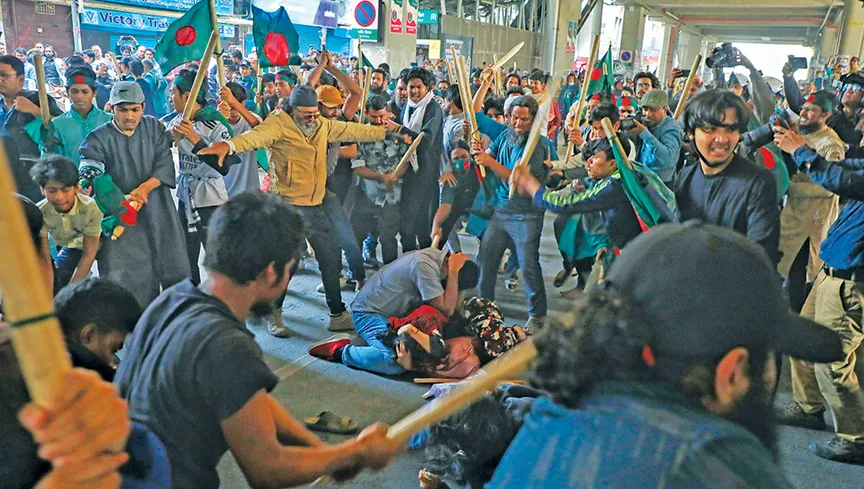
The violent attack was carried out against Indigenous students and rights activists during their peaceful protest in front of the National Curriculum and Textbook Board (NCTB) office in Dhaka, Bangladesh, on 15 January 2025. At least 19 persons were severely injured in this attack allegedly carried out by the members of “Students for Sovereignty”, a communal organisation that opposed the inclusion of the term “Adivasi” in a school textbook.
The injured include Ananta Bikash Dhamai, Don Jetra, Jewel Marak, Rupaya Shrestha Tanchangya, Tony Chiran, Isaba Shuhrat, Futanta Chakma, Donai Mro, Rengyoung Mro, Sneha Lal Tanchangya, Shanta Chakma, Sushmi Chakma, Angel Chakma, Sushanto Chakma, Michel Tripura, Malay Bikash Tripura, Shoili Chakma, Rahi Nayab, and Robi Biswas.
We welcome the inclusion of the “Adivasi” by the National Curriculum and Textbook Board (NCTB) in their recently published (online) Bangla Grammar and Composition textbook for the 9th and 10th graders. The artwork of a tree comprising five leaves: Adivasi, Hindu, Muslim, Buddhist, and Christian respectively, along with the caption “to pluck leaves is prohibited”, was featured on its back cover. The artwork included a title: “Do not hurt anybody’s feelings”/“Do not hurt anybody”. Inspired by the spirit of July Uprising of 2024, this graffiti relays the vision for an inclusive Bangladesh that protects and promotes ethnic and religious diversity.
However, the inclusion of the term “Adivasi” in the in the textbook sparked protest from an organization named ‘Students for Sovereignty’. It staged a demonstration inside the NCTB office in Dhaka on 12 January, 2025 demanding the removal of the artwork and any mention of the term “Adivasi” in the textbook, saying it was not in line with the constitution. Responding to the protest, the NCTB acknowledged that it was an “error” and replaced the artwork featuring the term “Adivasi” with the image of a poem on the same day. However, the members of this organisation were not satisfied with this step and declared to go for further protests with the demand to bring the people behind the inclusion of the term “Adivasi” to justice.
This action by the NCTB prompted a protest among the Indigenous Peoples and [progressive] Bengalis. On 15 January, Indigenous students and activists under the banner “Aggrieved Indigenous Students-Masses” declared to stage a peaceful demonstration in front of the NCTB office to protest the removal of the artwork and to demand its restoration. As the Indigenous protesters reached the NCTB office, around a hundred members of the ‘Students for Sovereignty’ launched a sudden barbaric attack on them with cricket stumps and sticks, leaving at least 19 persons, including Indigenous students, activists, and journalists, seriously injured. The injured persons were rushed to Dhaka Medical College Hospital and other hospitals in Dhaka.
This violent attack on the peaceful Indigenous protesters sparked protests across the country. Indigenous and Bengali students, teachers, activists, and members of civil society arranged protest demonstrations in Dhaka and different parts of the country. On 16 January, Indigenous youths and their supporters organized a march towards the home ministry under the banner Aggrieved Students-Masses from the Dhaka University campus. However, police obstructed the march with barricades and used water cannons and charged batons to disperse the protesters, injuring seven more on that day.
Honourable Chief Adviser,
We welcome your recent statement condemning the attack on indigenous students and your assurance of taking action. On the following day of the brutal attack, you strongly condemned this attack and stated that your government ordered an investigation into the attack, and two persons had already been arrested in this connection. We welcome your commitment to identify and arrest the perpetrators and prompt justice for the victims.
Honorable Nobel Laureate,
The use of the term Indigenous Peoples is not new in Bangladesh, the Government of Bangladesh has enacted different Acts, ordinances and Policies to protect and promote the rights, socio-economic development and cultural diversity of Indigenous Peoples in a broad range of areas. The National Education Policy stipulates the rights of indigenous children to receive an education in their mother tongue language. Similarly, the Bangladesh Shilpakala Academy Act 1989, Bangladesh Folk Art and Crafts Foundation Act 1998, Bangladesh National Cultural Policy 2006 and Small Ethnic Groups Cultural Institution Act 2010 lay down a number of stipulations for the promotions and protection of the cultural traditions and heritage of ethnic communities with the objective of ensuring cultural diversity of the nation. The ‘Small Ethnic Groups Cultural Institutions Act 2010’ mentioned in the definition of small ethnic groups means the country’s Indigenous Peoples. Article 23A of the constitution of Bangladesh states, “The State shall take steps to protect and develop the unique local culture and tradition of the tribes, minor races, ethnic sects and communities.”
Moreover, Bangladesh is a signatory to and has ratified several international human rights instruments. The country has yet to ratify the ILO Indigenous and Tribal Peoples Convention, 1989 (No. 169), but it ratified the Indigenous and Tribal Populations Convention, 1957 of the ILO (C-107) in 1972. Bangladesh has an obligation to respect the United Nations Declaration on the Rights of Indigenous Peoples (UNDRIP) 2007 as a Member State of the United Nations. Similarly, Bangladesh is a party to various UN and other multilateral institutions, whereby the policies on Indigenous Peoples of these institutions apply to the country.
Honourable Chief Adviser,
We appreciate that in a speech to the nation on August 25, you, as a Chief Adviser of the interim government of Bangladesh, mentioned the term ‘Adivasi’ while denoting the Indigenous Peoples of the country. We welcome your leadership and taking the oath as the head of the interim government following widespread protests against the previous government and reiterating your commitment and framework to make Bangladesh free of discrimination. One of the most compelling aspects of the July-August student movement was its ability to bridge political and ideological divides, bringing together people from various backgrounds to foster a diverse and inclusive Bangladesh. We hope Indigenous Peoples will not be left behind in these aspects.
We therefore urge your government to:
- Take prompt action to arrest all perpetrators involved in the attacks on Indigenous students and activists following and initiate impartial investigation to bring all perpetrators to justice.
- Arrange for free medical treatment and compensation to those injured in the attacks on the incidents that happened on 15th and 16th January and ensure the security of all indigenous protesters and their families and supporters.
- Reinstate the artwork with the word “Adivasi” in the textbook and take appropriate steps to properly represent indigenous communities’ cultures, traditional values and history to the new generation with respect.
- Recognize Indigenous Peoples in the constitution and recognize their individual and collective rights, including their right to self-determination and Free Prior and Informed Consent (FPIC). Formulate an Indigenous Peoples Rights Act in light of international human rights standards.
- Declare a road map with a clear timeframe for speedy, proper and full implementation of the Chittagong Hill Tracts Accord of 1997.
- Ratify ILO Convention No. 169 on Indigenous and Tribal Peoples of 1989 and endorse the United Nations Declarations on the Rights of Indigenous Peoples.
- Ensure meaningful and effective engagement of Indigenous Peoples before formulating, reforming, or repealing of any laws and policies concerning their rights and wellbeing.
Contact Us
Asia Indigenous Peoples Pact (AIPP)
112 Moo 1, Tambon Sanpranate, Amphur Sansai, Chiang Mai 50210, Thailand
Phone: +66(0) 53 343 539
Fax: +66 (0) 53 343 540
[email protected]