
Citizens’ Report on Security and Insecurity
12 August 2024
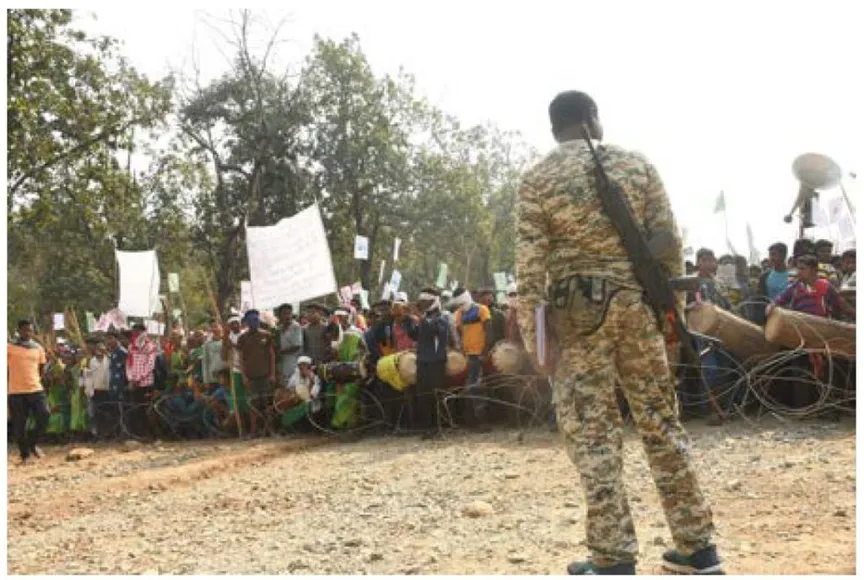
In the last few years, there have been large-scale protests by Adivasi communities across the Bastar region of Chhattisgarh against the proliferation of security camps on their lands. According to the Home Minister, Amit Shah, 250 security camps have been established after 2019.1 There are camps roughly at a distance of every 2 – 5 km, turning Bastar into one vast cantonment. In February 2024, the IG Bastar announced 50 additional camps. This also means that Bastar is one of the most militarized regions of the country with one security person to every nine civilians.
In some cases, such as at Silger in Sukma District, these protests have been continuing for over three years. These are peaceful, youth-led movements under the banner of the Moolvasi Bachao Manch (South Bastar), and various movements in North Bastar such as the Bastar Jan Sangharsh Samanvay Samiti. They are demanding the right to be consulted on anything that affects them, as guaranteed under the fifth Schedule of the Constitution, as well as protesting against illegal appropriation of their lands. Compared to movements elsewhere in the country- whether the year-long farmers’ protest, citizenship protests, or protests for reservations – the sustained demonstrations against security camps in Bastar have barely received any regional or national attention, either from the media or the public. Both the state as well as union government have consistently ignored the constitutional demands that the protestors are raising.
Do camps make people more secure or insecure? The government claims that setting up camps is necessary to ensure ‘area domination’ and control the spread of the Maoist movement. It also claims that the paramilitary camps are necessary for laying roads, constructing schools, health centres and voting booths, all of which are needed for state services. They also claim that the protests against the camps are ‘Maoist instigated’ as they are nervous about the incursion of security forces.
However, the villagers say that the camps make them feel more insecure and take away their livelihood. They believe, based on the layout, that the camps are meant for the safety of mining companies. Local communities say that camps and mining pose an existential threat to them.
A group of concerned citizens came together in February 2023 to investigate the claims and counter claims. This report is a result of that investigation, as well as subsequent material.
Mining: The Bastar region is known for its rich iron ore and other mineral deposits. Dantewada alone contributes about 50% of the state’s mineral revenue. As of 2022, 51 mining leases have been granted in the Bastar region, of which only 14 are with the Public Sector.
Roads, Camps and Mining: Camps and road laying are intrinsically connected. People state that they are not opposed to the building of roads per se, but it is their constitutional right to be consulted in how and where these roads are being built. The layout and width of the roads makes it quite clear in many cases that they are meant to facilitate mining operations. The roads are not accompanied by public transport services or other services for villagers.
Arrests: The proliferation of camps has been accompanied by mass arrests, including of many elected representatives, and member of the Moolvasi Bachao Manch. Framing people under Maoist charges is an easy way to silence their legitimate constitutional demands. Based on official figures, 6,804 arrests have been made in Bastar region from 2011 to 2022.
Fake Encounters and Drone Attacks: The presence of camps and forces like the District Reserve Guards (DRG) has increased the incidences of fake encounters: 2023–2024 has seen a spike in the incidents of extrajudicial killings of alleged Naxalites and civilians. Between 1 January and 15 July 2024, there have been 141 killings. The villagers have pointed out that many of those killed are ordinary civilians, shot in staged encounters. The villagers have also shown evidence of drone attacks and the firing of grenades.
Lack of Due Process in Setting Up Camps: Most of the camps are set up without due process. Quite often, they are set up in the middle of the night without informing the local communities, let alone after holding a proper consultation with them. Lands cultivated by villagers over generations are appropriated without any compensation. A camp also bringswith it huge destruction of village commons, sacred burial sites and sacred groves. There has been severe repression on villagers protesting against the camps.
Securitization of Welfare: Instead of revamping the health infrastructure, like reactivating defunct primary centres and making sub-centres functional, the government is providing health facilities within the security camps and forcing people to interact with the paramilitary forces if they are to avail their basic entitlements as citizens. The weekly market, which is the lifeline for the communities has also been subject to police controls. The timings have been reduced, and the purchases are monitored, supposedly to ensure that no supplies reach Maoists.
Violation of PESA and FRA: Most importantly, the government is silent on the legitimate demands of people, viz. that camps, roads and mines should not come up on their private or community property without their consent as is mandated by provisions of the Panchayat (Extension to Scheduled Areas) Act, 1996 (PESA). Under the Scheduled Tribes and Other Traditional Forest Dwellers (Recognition of Forest Rights) Act, 2006, scheduled tribes have community rights or rights over common property resources /forests. These are being ignored.
To summarize, there are several aspects of the securitization through camps which stand out:
- The absence of land records and surveys being used by the administration to enable the
appropriation of cultivated land; - Lack of consent before any projects are taken up as constitutionally mandated by PESA,1996
and FRA,2006; - Lack of accountability for massive deforestation
- No recognition of forest rights;
- Severe repression on villagers who gather to oppose this take-over of land;
- Increased surveillance at camp checkpoints, making everyday life difficult for villagers;
- Welfare measures are undertaken very slowly or rarely in comparison to the speed with
which camps and roads are built; - The network and scale of roads being laid are a clear indication of government’s priorities
and intent. It is clear the roads are not for the local communities but for the state and
corporates to access and exploit the lands on which the communities reside
Click here to download the full report on Security and Insecurity
Like this article?
Share on Facebook
Share on Twitter
Share on Linkdin
Share on Pinterest
Contact Us
Asia Indigenous Peoples Pact (AIPP)
112 Moo 1, Tambon Sanpranate, Amphur Sansai, Chiang Mai 50210, Thailand
Phone: +66(0) 53 343 539
Fax: +66 (0) 53 343 540
[email protected]